ISO 9001:2000
TL;DR: Quick lime for construction serves as an essential chemical reagent, binder, and soil stabilizer across infrastructure and building material manufacturing. Produced by the thermal decomposition of limestone into calcium oxide (CaO), quick lime provides high reactivity and available CaO for autoclaved aerated concrete (AAC) blocks, mortar formulations, and heavy clay subgrade stabilization. Chemical & Mineral Industries Private Limited (CMIPL) manufactures quick lime in lump and powder grades.
The Essential Role of Quick Lime for Construction and Building Materials
In commercial construction and civil infrastructure, quick lime (calcium oxide) provides rapid chemical reactivity that conventional aggregates and standard binders cannot replicate. When limestone (calcium carbonate) undergoes calcination above 900°C, carbon dioxide is driven off, leaving high-calcium quick lime. In construction processes, calcium oxide acts as an active chemical component rather than an inert filler.
When combined with water, quick lime undergoes an exothermic reaction that produces calcium hydroxide while releasing significant thermal energy. This reaction is fundamental to modifying the plasticity of moist soils, curing masonry components, and activating pozzolanic reactions in composite building materials. Because quick lime contains a higher concentration of available calcium oxide per ton than hydrated lime, commercial civil contractors and material manufacturers use quick lime to reduce freight weight and accelerate chemical binding reactions on large work sites.
Quick Lime in Autoclaved Aerated Concrete (AAC) Block Production
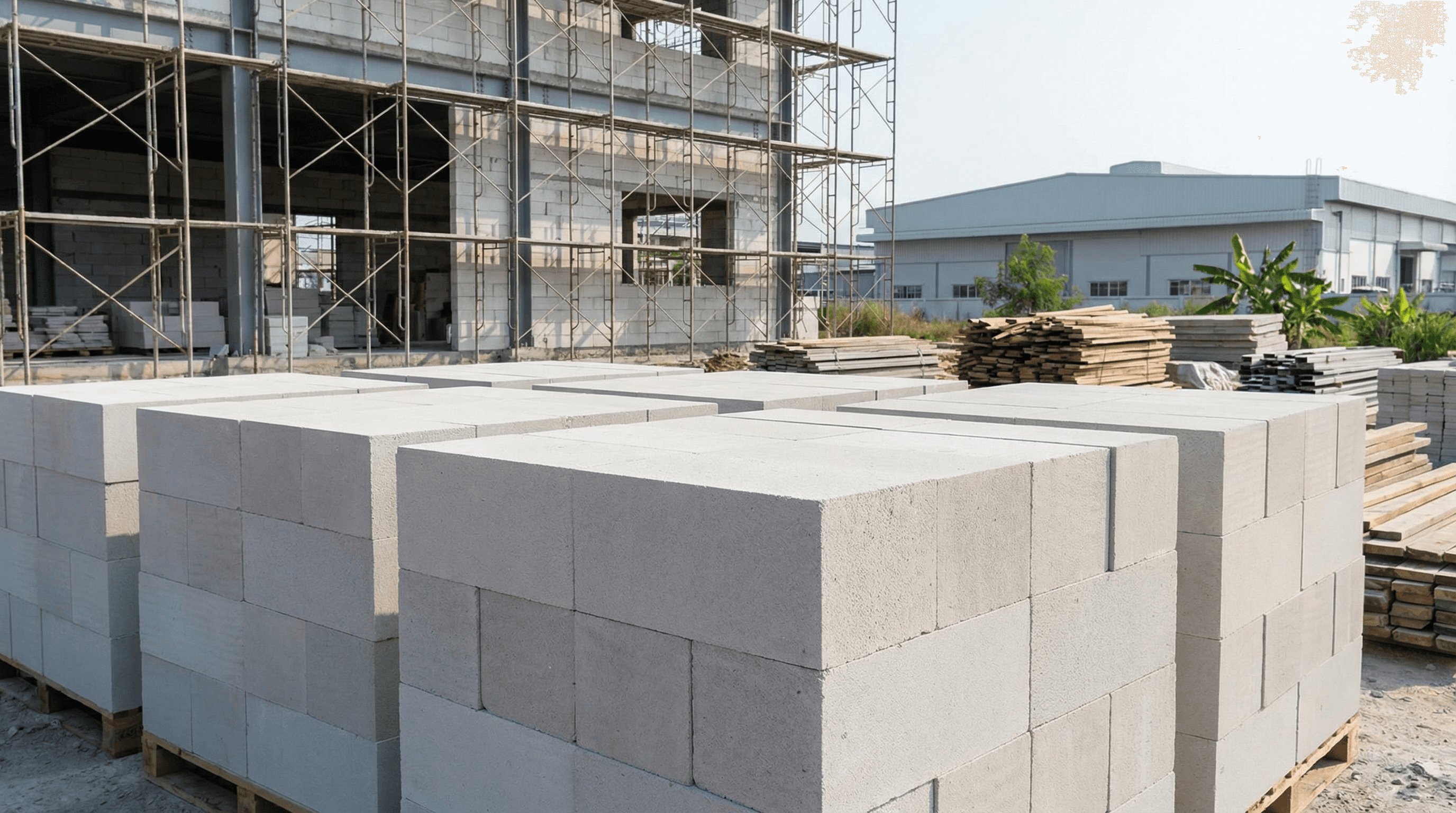
Lime products are used in production processes of building materials such as autoclaved aerated concrete blocks (AAC blocks). In AAC manufacturing, quick lime acts as a stabilizer, aiding the chemical reactions that give AAC blocks their structural strength, thermal insulation, and lightweight physical properties. Modern AAC blocks have increasingly replaced traditional red clay bricks, offering an alternative that eliminates topsoil depletion.
During AAC batching, powdered quick lime is mixed with finely ground silica sand or fly ash, water, cement, and a minute quantity of aluminum powder. The quick lime reacts immediately with water, releasing heat that accelerates slurry setting. Simultaneously, the alkaline reaction between calcium hydroxide and aluminum powder releases hydrogen gas, creating millions of microscopic, evenly distributed air voids. The calcium oxide subsequently reacts with available silica during high-pressure autoclaving to form crystalline tobermorite, providing cured blocks with high compressive strength.
Soil Stabilization and Subgrade Improvement in Civil Engineering
Civil engineering projects frequently encounter expansive clay subgrades that lack adequate shear strength and California Bearing Ratio (CBR) values. Quick lime provides an effective method for treating water-saturated, heavy clay soils beneath road pavements, airport runways, railway embankments, and industrial slabs.
The stabilization process operates across two stages:
Calcium ions replace sodium and potassium ions on clay mineral surfaces, causing soil particles to flocculate into granular, friable textures with reduced plasticity.
Long-term pozzolanic reactions: The elevated pH created by calcium oxide dissolves silica and alumina from soil clays. These compounds react with calcium over months to form calcium silicate hydrates (CSH) and calcium aluminate hydrates (CAH), binding soil into a durable, moisture-resistant matrix.
Comparing Quick Lime and Hydrated Lime for Building Projects
Specifiers choose between quick lime (CaO) and hydrated lime (Ca(OH)2) based on project moisture levels, reactivity requirements, and on-site processing equipment.
Property / Parameter | Quick Lime (Calcium Oxide, CaO) | Hydrated Lime (Calcium Hydroxide, Ca(OH)2) |
|---|---|---|
Physical Form | Lump (5-75 mm) or Fine Powder | Dry, ultrafine powder |
Water Reaction | Highly exothermic; generates heat and steam | Chemically inert with water; no heat release |
Moisture Consumption | Consumes water actively from moist soil | Does not consume water during placement |
Primary Construction Uses | AAC blocks, soil drying, heavy subgrades | Mortar mixes, plasters, asphalt anti-stripping |
Bulk Handling Needs | Moisture-proof silos; sealed containers | Standard paper/polypropylene bags or silos |
Quick lime provides economic advantages in bulk logistics because contractors avoid transporting the bound water weight present in hydrated lime. For hydrated lime, see hydrated lime for water treatment.
Chemical Specifications, Available CaO, and Reactivity Grades
The effectiveness of quick lime in civil construction depends on its chemical purity, total active calcium oxide content, and slaking rate. Total calcium content reflects all calcium present in the mineral, whereas available CaO represents the uncombined calcium oxide accessible for immediate chemical reaction.
On-Site Slaking and Exothermic Heat Management
Slaking quick lime on a construction site requires controlled water ratios, appropriate vessel agitation, and strict temperature monitoring. When calcium oxide combines with water, the reaction releases a large amount of heat, so water temperatures rapidly approach boiling point with significant steam release.
Storage, Moisture Protection, and Handling Protocols
Because quick lime reacts readily with ambient moisture and carbon dioxide, proper site storage is essential to prevent premature hydration and recarbonation. Exposure to air degrades available CaO into calcium hydroxide and calcium carbonate, diminishing chemical performance in AAC molds and soil stabilization. Ask the supplier for its packing options and how it protects the lime from moisture in transit.
Bulk Quick Lime Production Capacity and Supply from CMIPL
Reliable construction schedules need a supplier with consistent particle sizing. Chemical & Mineral Industries Pvt. Ltd. (CMIPL), founded in 1967 and based in Jodhpur, operates three lime kilns with a combined production capacity of 1200 TPD, including a pet-coke fired Twin-D lime kiln at Boranada, and is ZED Certified by the Ministry of MSME of India.
CMIPL supplies quick lime across multiple sizing profiles, including QL 5-25 mm, QL 25-75 mm, QL powder 0-3 mm, 200 Mesh, and 300 Mesh powder. This size range allows AAC manufacturers to source fine mesh powders for precision slurry mixing, while earthwork contractors can procure graded lumps for reduced dust during ground preparation. Industrial pricing is quoted per order based on volume, delivery schedule, and physical specification.
Frequently asked questions
What is the function of quick lime in soil stabilization?
Quick lime rapidly reduces soil moisture through an exothermic reaction that consumes water and generates heat. It alters clay mineral structures through cation exchange to reduce soil plasticity, while initiating long-term pozzolanic reactions that increase subgrade load-bearing capacity and shear strength.
Why is high-reactivity quick lime required for AAC block manufacturing?
AAC block manufacturing relies on rapid heat release and alkaline conditions to trigger the foaming reaction between aluminum powder and calcium hydroxide. High-reactivity quick lime ensures consistent rising times in molds and develops sufficient green strength in the cake prior to wire cutting and autoclaving.
What is the difference between quick lime and hydrated lime in construction?
Quick lime is unslaked calcium oxide (CaO) that reacts exothermically with water, consuming moisture and producing heat. Hydrated lime is calcium hydroxide (Ca(OH)2), which is pre-slaked with water, non-exothermic, and predominantly used in dry mortar formulations and plasters.
What available CaO percentage is ideal for construction-grade quick lime?
Higher active calcium oxide percentages reduce the total tonnage needed for soil stabilization and ensure predictable chemical performance in building material formulations.
How does quick lime improve the load-bearing capacity of clayey soils?
Quick lime combines with water and releases calcium ions that cause fine clay particles to flocculate into coarser, granular aggregates. Over time, the high alkaline pH dissolves soil silica and alumina, forming permanent calcium silicate hydrate bonds that substantially raise the subgrade California Bearing Ratio (CBR).
What safety precautions are necessary when slaking quick lime on site?
Workers must use protective face shields, dust respirators, safety goggles, and thermal-resistant gloves to prevent chemical burns from alkaline slurry and steam. Controlled water-to-lime ratios and mechanical agitation are required to manage exothermic temperatures that can reach 100°C.
What particle sizes of quick lime are available from CMIPL?
CMIPL supplies quick lime in graded lumps of 5-25 mm and 25-75 mm, as well as 0-3 mm powder, 200 Mesh, and 300 Mesh sizes. Buyers can select sizes matching pneumatic delivery systems, slurry batching plants, or bulk earthwork requirements.
Contact CMIPL to discuss the quick lime size, volume and delivery for your construction project.