ISO 9001:2000
TL;DR: Calcium carbonate for leather and rubber processing acts as a functional filler and compounding additive. In rubber, precipitated calcium carbonate (PCC) and activated calcium carbonate (ACC) improve tensile strength, tear resistance, flexibility, and dimensional stability. In synthetic leather and PVC leather cloth, coated grades enhance surface smoothness and resin dispersion. CMIPL manufactures synthetic PCC and surface-treated ACC grades to support industrial elastomer and polymer processors.
Role of Calcium Carbonate in Rubber Compounding
In rubber manufacturing, mineral fillers are necessary for cost control, structural reinforcement, and dimensional stability. Unfilled elastomer compounds often lack the stiffness and mechanical integrity required for industrial duty. Incorporating precipitated calcium carbonate into natural and synthetic rubber formulations enhances tensile strength, tear resistance, and elongation properties. Because synthetic calcium carbonate provides consistent crystal morphology and fine particle size distribution, it disperses thoroughly during mechanical compounding. This uniform dispersion prevents the formation of weak stress points in vulcanized elastomer matrices. Compounding processors rely on PCC to increase abrasion resistance, control compound viscosity, and improve surface smoothness across extruded and molded rubber goods. Furthermore, its natural whiteness and brightness provide base opacity, which supports stable coloration and precise shade matching in pigmented rubber products.
Activated Calcium Carbonate Versus PCC and GCC in Elastomers
Selecting the appropriate mineral filler depends on the polarity of the rubber matrix and mechanical performance goals. Ground calcium carbonate (GCC) provides cost-effective bulk volume but features coarse, irregular particles that can decrease compound elongation and flex fatigue resistance. Precipitated calcium carbonate offers finer particle sizes and consistent morphology, delivering moderate reinforcement. However, untreated mineral surfaces remain naturally hydrophilic, which can resist rapid wetting in hydrophobic rubber formulations. Activated calcium carbonate (ACC) resolves this challenge through organic surface modification. By coating ultrafine PCC particles with fatty acids such as stearic acid and titanate coupling agents, the mineral surface becomes organophilic. In rubber mixing, ACC lowers melt viscosity, reduces internal shear friction, and improves filler-polymer bonding, resulting in higher impact strength, smoother extrusion profiles, and reduced die wear.
Calcium Carbonate Applications in Synthetic Leather and PVC Cloth
In the production of synthetic leather, artificial leather cloth, and PVC-coated fabrics, calcium carbonate serves as a functional extender that directly influences hand feel, flexibility, and surface finish. Manufacturers apply polymer plastisols onto textile backings to create artificial leather for automotive upholstery, footwear, luggage, and apparel. Incorporating ultrafine activated calcium carbonate into these PVC plastisols stabilizes rheological behavior and prevents filler sedimentation during coating operations. Surface-treated ACC ensures rapid wetting within plasticizers and vinyl resins, yielding smooth, pinhole-free films with consistent grain retention. In artificial leather formulations, high-purity synthetic carbonates maintain softness and suppleness while preventing surface chalking or cracking during repeated flexing. The controlled particle size also prevents surface micro-roughness, preserving the desired matte or glossy texture of finished synthetic leather goods.
Hydrated Lime and Mineral Functions in Leather Processing
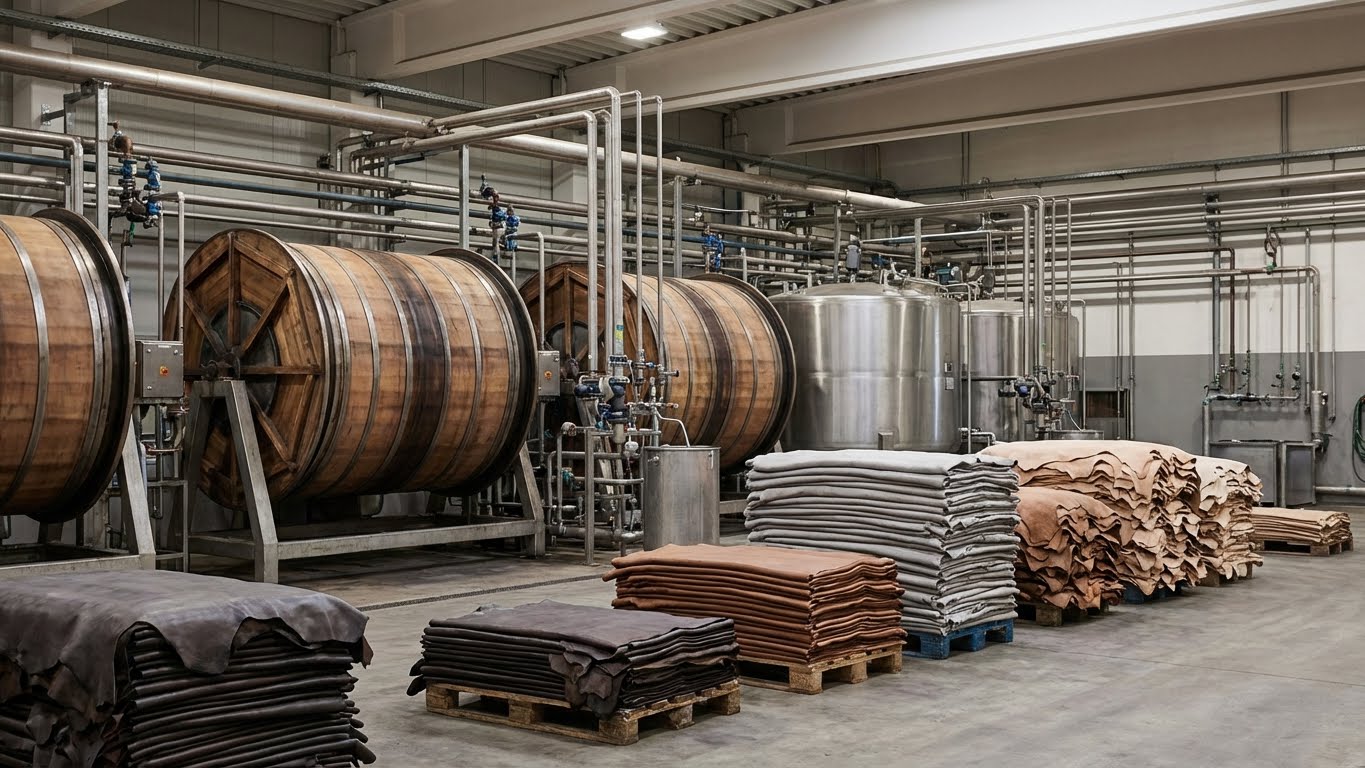
Beyond synthetic leather compounding, traditional tannery operations depend on calcium minerals during early hide preparation stages. Hydrated lime plays a primary role in the beamhouse operations of leather manufacturing, specifically during the dehairing and liming processes. When introduced into processing drums or pits, hydrated lime creates an alkaline medium that swells the hide structure. This controlled swelling breaks down interfibrillary non-collagen proteins, dissolves hair roots, and hydrolyzes natural fats within raw hides. The action of lime loosens the epidermis, enabling clean hair removal and opening the dermal fiber network to prepare hides for subsequent deliming, bating, and tanning.
Evaluating Technical Parameters: Particle Size, Dispersion, and Absorption
Procurement teams and compounding chemists must evaluate specific physical and chemical parameters when sourcing calcium carbonate for leather and rubber manufacturing. Particle size distribution is the primary determinant of reinforcement; finer sub-micron particles provide higher surface area for polymer interaction, directly enhancing tensile and tear strength. Oil absorption, measured in grams of oil per 100 grams of filler, governs plastisol viscosity and plasticizer demand in synthetic leather compounding. Lower oil absorption grades permit higher filler loadings without stiffening the compound. Moisture content must remain minimal to avoid blistering, porosity, or steam voids during high-temperature vulcanization and extrusion. Finally, surface coating uniformity in activated grades dictates dispersion speed and agglomerate prevention during banbury mixing, ensuring stable mechanical performance across finished batches.
Performance in Footwear Soles and Molded Rubber Goods
The footwear industry represents one of the largest consumers of functional mineral fillers for rubber components. In molded soles, microcellular sheets, and rubber footwear, manufacturers incorporate PCC in Footwear to balance mechanical durability with economical compound formulation. Precipitated calcium carbonate acts as an active filler in rubber slippers and outsoles, providing resistance against wear, flex cracking, and abrasion during prolonged wear. Its fine, uniform particles allow rubber soles to maintain flexibility and resilience without becoming brittle under repeated dynamic stress. In colored and white footwear compounds, high whiteness ensures clean aesthetic presentation without dulling bright pigments. Similar compounding benefits apply to industrial molded rubber goods, including grommets, vibration pads, automotive weatherstrips, and conveyor belting, where dimensional stability and tear strength remain essential.
CMIPL Calcium Carbonate Grades and Manufacturing Capacity
Chemical & Mineral Industries Pvt. Ltd. (CMIPL), founded in 1967 in Jodhpur, India, manufactures industrial mineral solutions with three lime kilns providing a combined production capacity of 1200 TPD. For leather and rubber compounders, CMIPL manufactures synthetic Precipitated Calcium Carbonate under the Vical-D grade, characterized by an ultrafine crystalline powder structure and uniform dispersibility. For applications requiring hydrophobic surface properties and polymer compatibility, CMIPL produces Activated Calcium Carbonate in grades including Vical-S, Vical-S1, Vical-SF, Vical-C, and Vical-T. These ACC grades are surface-modified with fatty acids and titanate coupling agents to enhance processing efficiency in PVC leather cloth, synthetic elastomers, and molded rubber. Industrial pricing is quoted per order based on volume, delivery destination, and product grade.
Frequently asked questions
Why is calcium carbonate used in rubber manufacturing?
Calcium carbonate functions as a reinforcing filler and cost-reducing extender in rubber compounding. It enhances mechanical attributes including tensile strength, tear resistance, and dimensional stability while improving compound processability and surface finish.
How does Activated Calcium Carbonate (ACC) improve rubber compounding?
ACC features an organic fatty acid coating that converts hydrophilic mineral surfaces into hydrophobic, organophilic particles. This modification improves resin wetting, lowers compound melt viscosity, reduces internal friction during mixing, and prevents particle agglomeration.
What role does calcium carbonate powder play in synthetic leather production?
In synthetic leather and PVC leather cloth, ultrafine calcium carbonate stabilizes plastisol viscosity and provides bulk structure. Surface-treated grades disperse smoothly into plasticizers, delivering uniform film thickness, supple hand feel, and defect-free surface grain.
What is the difference between PCC and GCC in rubber applications?
Ground calcium carbonate (GCC) is produced by mechanically milling natural limestone, yielding coarser, irregular particles suitable mainly as bulk extenders. Precipitated calcium carbonate (PCC) is synthetically synthesized, offering finer particle sizes and uniform crystal morphology that provide superior reinforcement and whiteness.
How does hydrated lime function in traditional leather processing?
Hydrated lime is utilized in the beamhouse dehairing and liming stages of leather tanning. It creates an alkaline solution that swells raw hides, breaks down non-collagenous proteins, loosens hair follicles, and prepares the hide structure for tanning.
How does particle size affect the mechanical properties of vulcanized rubber?
Finer calcium carbonate particles provide greater contact surface area with the rubber matrix, increasing compound tensile strength, abrasion resistance, and tear properties. Conversely, coarser particle fractions reduce reinforcement and can lower dynamic flex fatigue resistance.
What grades of calcium carbonate does CMIPL supply for leather and rubber?
CMIPL supplies Precipitated Calcium Carbonate under the Vical-D grade for general compounding and footwear. For polymer and rubber applications requiring surface treatment, CMIPL manufactures Activated Calcium Carbonate in Vical-S, Vical-S1, Vical-SF, Vical-C, and Vical-T grades.
How can industrial compounders obtain pricing for CMIPL calcium carbonate grades?
Pricing is quoted per order based on the product grade, order volume and delivery location.
Contact CMIPL to discuss the calcium carbonate grade for your rubber or leather compound.