ISO 9001:2000
TL;DR: In commercial detergent manufacturing, precipitated calcium carbonate (PCC) serves as an essential functional mineral filler and whitening agent for laundry powders and detergent bars. Formulators rely on PCC to improve brightness, support mild mechanical scrubbing, regulate pH balance, and reinforce structural hardness in detergent cakes. CMIPL supplies high-purity precipitated calcium carbonate manufactured with controlled particle properties, helping detergent producers optimize batch costs.
The Role of Precipitated Calcium Carbonate in Detergent Formulations
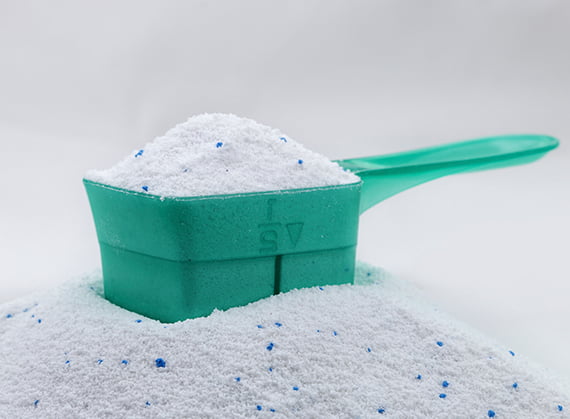
Detergent manufacturing demands a precise balance between active cleaning agents and structural mineral ingredients. Precipitated calcium carbonate functions as an eco-friendly and non-toxic functional filler in commercial laundry powders and extruded detergent bars. Unlike inert materials that merely add dead weight, high-purity PCC actively improves formulation efficiency. It disperses evenly within detergent dry blends, acting as a carrier for surfactants and fragrance compounds while preventing particle agglomeration during storage.
In powdered formulations, synthetic calcium carbonate contributes directly to uniform bulk density and consistent powder flowability during automatic filling and packaging. Because PCC is manufactured through controlled chemical carbonation rather than simple mechanical grinding, formulators obtain fine particle consistency and high chemical purity. This controlled morphology prevents gritty residues in wash water, allowing active surfactants to dissolve and generate foam efficiently without physical interference.
Enhancing Washing Performance and Brightness in Laundry Powders
Visual appeal and cleaning performance define consumer detergent quality. Precipitated calcium carbonate acts as an effective whitening agent that elevates the overall brightness and optical presentation of laundry powders. Its high intrinsic whiteness eliminates the grey or yellow undertones common in base surfactant pastes and crude builder blends, reducing the reliance on costly synthetic optical brighteners.
Beyond optical enhancement, PCC improves washing performance through gentle scrubbing action. Its ultrafine particles assist in lifting particulate soil, grease, and mechanical stains from textile fibers during mechanical agitation. Because the particles are chemically uniform and free of hard crystalline quartz impurities, this scouring effect cleans surfaces without causing fiber abrasion, fabric thinning, or dullness over repeated washing cycles. The resulting wash liquor maintains steady suspension of dislodged dirt particles, helping avoid redeposition on fabrics.
Improving Hardness and Physical Durability in Detergent Bars
Detergent bars and laundry cakes present specific structural challenges during high-speed extrusion, stamping, and domestic use. A common defect in lower-grade laundry bars is rapid water absorption, which causes structural softening, surface slime, and structural collapse, commonly referred to in the industry as bar mush. Precipitated calcium carbonate acts as a reinforcing mineral skeleton that adds essential hardness to detergent bars.
By integrating PCC into the soap and synthetic surfactant mass, manufacturers achieve solid green strength during extrusion and clean stamp definition during cutting. The mineral particles bind closely within the fatty acid and builder matrix, increasing resistance to physical breakage during bulk packing and transit. In routine wet use, the dense particulate network restricts capillary moisture penetration, helping the bar maintain dimensional integrity and firmness even when stored in wet wash environments.
Alkaline Buffering and pH Balance in Cleaning Systems
Washing efficiency depends heavily on the chemical environment of the wash liquor. Most commercial surfactants, particularly linear alkylbenzene sulfonates and non-ionic blends, perform best within controlled alkaline ranges. Precipitated calcium carbonate naturally maintains pH balance across the washing cycle by serving as a mild alkaline buffering agent.
When detergents dissolve in hard or acidic wash water, sudden fluctuations in chemical balance can destabilize active surfactants and reduce soil suspension. PCC stabilizes the wash solution by buffering acidic soil components introduced from soiled clothing. This buffering capacity preserves surfactant stability without requiring aggressive alkaline additives like sodium hydroxide, which can irritate skin and degrade fabric longevity. Consequently, formulators achieve balanced cleaning power that protects both the cleaning chemistry and fabric fibers.
Formulation Economics and Mineral Filler Selection
The commercial detergent sector operates on competitive margins where active ingredient costs fluctuate constantly. Formulators must balance chemical builders, enzymes, and active matter with cost-effective mineral materials that protect end-product performance. Incorporating precipitated calcium carbonate directly lowers raw material expenses by replacing costlier base components without compromising product brightness or washing action.
When choosing mineral supplies, industrial buyers evaluate purity, particle dispersion, and moisture levels. Lower-grade raw minerals often contain abrasive silica or heavy metal residues that disrupt enzyme stability and stain fabrics. Synthetic PCC offers a reliable, chemically non-toxic mineral profile with consistent calcium content, making it appropriate for institutional, retail, and household detergent formulations. The list below outlines how mineral properties influence laundry detergent performance:
Optical appearance: PCC is a whitening agent that lifts the base colour, giving high brightness without excess optical brighteners.
Soil removal: mild, non-scratch mechanical scrubbing removes particulate dirt without fiber damage.
Cake durability: PCC reinforces the solid structure of bars, preventing softening, mush and transport cracking.
Solution stability: alkaline buffering in the wash liquor keeps the pH stable for surfactant action.
Cost optimization: a high-purity, non-toxic functional filler reduces cost per kilogram while sustaining quality.
Industrial Mineral Manufacturing and Supply at CMIPL
Chemical & Mineral Industries Pvt. Ltd. (CMIPL), established in 1967, was the first PCC company certified under ISO 9001:2008 and holds ZED Certification from the Ministry of MSME of India. It runs three lime kilns with a combined production capacity of 1,200 TPD, including a pet-coke fired Twin-D lime kiln at Boranada, Jodhpur, and reuses 100% of the carbon dioxide from limestone calcination in its precipitated calcium carbonate production.
For detergent manufacturers, CMIPL supplies Precipitated Calcium Carbonate (PCC) made for particle control and chemical purity. It also produces Activated Calcium Carbonate (ACC) in grades Vical-S, Vical-S1, Vical-C, Vical-SF and Vical-T, Quick Lime from 0-3 mm powder up to 300 Mesh, and talc powder. See the PCC product page. Commercial pricing is quoted per order based on volume, delivery and specification.
Frequently asked questions
What is the primary role of precipitated calcium carbonate in detergent powders?
Precipitated calcium carbonate functions as an eco-friendly filler and whitening agent in detergent powders. It enhances overall brightness, supports mild mechanical scrubbing action to loosen surface soil, and maintains uniform powder density.
How does PCC add hardness to laundry detergent bars?
In extruded detergent cakes, fine PCC particles form a dense internal mineral framework that increases structural strength. This reinforcement improves bar hardness, provides clean stamping during manufacturing, and reduces water absorption to prevent bar mush.
Does precipitated calcium carbonate scratch or damage textile fibers?
No, synthetic PCC particles are fine and free from hard silica impurities. They provide gentle mechanical scrubbing that lifts dirt from the weave without causing abrasive wear or surface damage to fabric threads.
How does calcium carbonate contribute to pH balance during washing?
Precipitated calcium carbonate serves as a mild alkaline buffering agent in wash water. It counteracts acidic soils washed out from clothing, stabilizing the solution pH so that active surfactants continue cleaning at peak efficiency.
Can detergent manufacturers use PCC to reduce batch costs?
Yes, PCC is a cost-effective mineral filler that allows detergent manufacturers to replace more expensive chemical components without compromising brightness, density, or washing efficacy. Its high purity supports consistent quality across bulk production runs.
Is precipitated calcium carbonate environmentally safe for laundry formulations?
Yes, PCC is an eco-friendly and non-toxic mineral compound. It does not release harmful residues or toxic chemicals into wash water systems, making it suitable for modern household and commercial cleaning formulations.
What grades of mineral products does CMIPL supply to cleaning and chemical industries?
CMIPL manufactures Precipitated Calcium Carbonate (PCC), Quick Lime from lump to powder sizes, Activated Calcium Carbonate (ACC) in several Vical grades, and Talc Powder. Pricing is quoted per order based on volume, delivery and specification.
Contact CMIPL to request mineral specifications or a commercial quote for precipitated calcium carbonate for your detergent manufacturing.
Last updated: 2026-11-03